
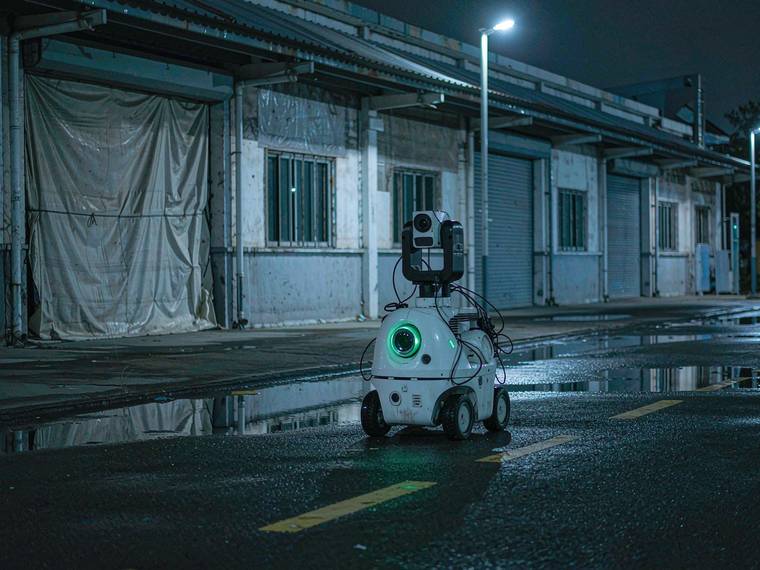
Ninety nights of perimeter patrol, zero false alarms
A perimeter robot that cries wolf is worse than no robot: after the third false alarm the guard stops walking out to look. Ninety nights without one is the whole specification.
The problem
The site is 11 hectares of open yard with a fence line that is 1.9 kilometres around. Two guards covered it on a rota that meant any given stretch of fence was walked roughly every ninety minutes.
The site had already tried fixed cameras. They worked, in the sense that they recorded everything, and did nothing, in the sense that nobody watched 4,300 hours of footage a month.
What we shipped
Two patrol units with thermal and LiDAR, and — more importantly — two weeks of supervised running before either was allowed out alone.
- Fusion — a detection has to be confirmed by both sensors. A fox is warm and moving; it is not 1.4 metres tall and solid.
- Calibration — the two weeks of supervised nights were spent tuning against the site's actual wildlife, weather and traffic, not against a test range.
- Response — an alert arrives with a fifteen-second clip attached, so the guard knows whether to walk out before standing up.
- Coverage — the fence line is now walked every 40 minutes instead of every 90, in the dark, in 45°C, without a person doing it.
Ninety nights, one detection — a genuine fence breach at the north-east corner, confirmed and responded to in under four minutes.
The result
Zero false alarms in ninety nights. The guard team's own measure is more useful than ours: they now respond to every alert at a run, because every alert so far has meant something.
The two guards were not replaced. One now covers the gate and the control room; the other covers the buildings, which is where the work that needs a person actually is.
Working on something like this? Talk to an engineer